
“Since before time and space were, the Tao is. It is beyond is and is not . How do I know this is true? I look inside myself and see.”
Lao Tzu Chapter 21 | interpreted by Stephen Mitchell (1992)
I painted these landscapes, which because of their surreal quality, read as Outer Space landscapes – a landscape on Mars or Venus or Exoplanet Kepler-186f or Vulcan or Caprica .


Exoplanet Kepler-186f , acrylic and gouache on paper, 9 in x 12 in, 2023 ( photographed + photoshop + reprinted giclee on paper, 18 in x 24 in, 27 in x 36 in, 36 in x 48 in, 2027)

Gliese 667Cc, acrylic and gouache on paper, 9 in x 12 in, 2023 ( photographed + photoshop + reprinted giclee on paper, 18 in x 24 in, 27 in x 36 in, 36 in x 48 in, 2027)

Exoplanet Nu2 Canis Majoris b, acrylic and gouache on paper, 9 in x 12 in, 2023 ( photographed + photoshop + reprinted giclee on paper, 18 in x 24 in, 27 in x 36 in, 36 in x 48 in, 2027)

Exoplanet Gliese 433 , acrylic and gouache on paper, 9 in x 12 in, 2023 ( photographed + photoshop + reprinted giclee on paper, 18 in x 24 in, 27 in x 36 in, 36 in x 48 in, 2027)

Exoplanet HAT-P-27 , acrylic and gouache on paper, 9 in x 12 in, 2023 ( photographed + photoshop + reprinted giclee on paper, 18 in x 24 in, 27 in x 36 in, 36 in x 48 in, 2027)

Exoplanet HD 137388 / Karaka , acrylic and gouache on paper, 9 in x 12 in, 2023 ( photographed + photoshop + reprinted giclee on paper, 18 in x 24 in, 27 in x 36 in, 36 in x 48 in, 2027)

Exoplanet GJ 3470 b / Phailinsiam , acrylic and gouache on paper, 9 in x 12 in, 2023 ( photographed + photoshop + reprinted giclee on paper, 18 in x 24 in, 27 in x 36 in, 36 in x 48 in, 2027)

Exoplanet KELT-2Ab , acrylic and gouache on paper, 9 in x 12 in, 2023 ( photographed + photoshop + reprinted giclee on paper, 18 in x 24 in, 27 in x 36 in, 36 in x 48 in, 2027)
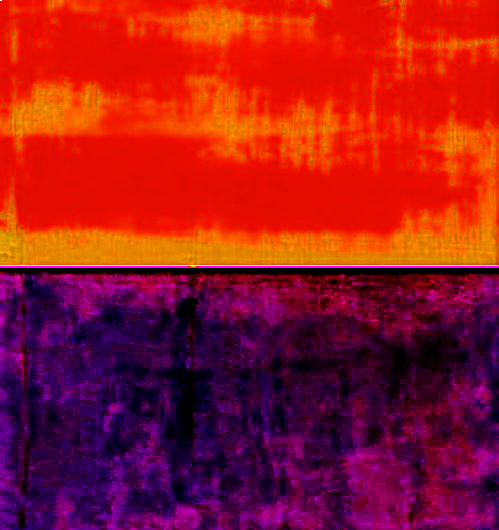
Exoplanet HD 40307 e , acrylic and gouache on paper, 9 in x 12 in, 2023 ( photographed + photoshop + reprinted giclee on paper, 18 in x 24 in, 27 in x 36 in, 36 in x 48 in, 2027)

Exoplanet HAT-P-38b/Hiisi , acrylic and gouache on paper, 9 in x 12 in, 2023 ( photographed + photoshop + reprinted giclee on paper, 18 in x 24 in, 27 in x 36 in, 36 in x 48 in, 2027)

Exoplanet Gliese 163 c, acrylic and gouache on paper, 9 in x 12 in, 2023 ( photographed + photoshop + reprinted giclee on paper, 18 in x 24 in, 27 in x 36 in, 36 in x 48 in, 2027)

Exoplanet KELT-6b , acrylic and gouache on paper, 9 in x 12 in, 2023 ( photographed + photoshop + reprinted giclee on paper, 18 in x 24 in, 27 in x 36 in, 36 in x 48 in, 2027)

Exoplanet Kepler-37 , acrylic and gouache on paper, 9 in x 12 in, 2023 ( photographed + photoshop + reprinted giclee on paper, 18 in x 24 in, 27 in x 36 in, 36 in x 48 in, 2027)

Exoplanet Kepler-138, acrylic and gouache on paper, 9 in x 12 in, 2023 ( photographed + photoshop + reprinted giclee on paper, 18 in x 24 in, 27 in x 36 in, 36 in x 48 in, 2027)

Kepler-22b. acrylic and gouache on paper, 9 in x 12 in, 2023 ( photographed + photoshop + reprinted giclee on paper, 18 in x 24 in, 27 in x 36 in, 36 in x 48 in, 2027)

Kepler-442b, acrylic and gouache on paper, 9 in x 12 in, 2023 ( photographed + photoshop + reprinted giclee on paper, 18 in x 24 in, 27 in x 36 in, 36 in x 48 in, 2027)

Kepler 1649c, acrylic and gouache on paper, 9 in x 12 in, 2023 ( photographed + photoshop + reprinted giclee on paper, 18 in x 24 in, 27 in x 36 in, 36 in x 48 in, 2027)

Proxima Centauri b, acrylic and gouache on paper, 9 in x 12 in, 2023 ( photographed + photoshop + reprinted giclee on paper, 18 in x 24 in, 27 in x 36 in, 36 in x 48 in, 2027)

Exoplanet Gliese 163 , acrylic and gouache on paper, 9 in x 12 in, 2023 ( photographed + photoshop + reprinted giclee on paper, 18 in x 24 in, 27 in x 36 in, 36 in x 48 in, 2027)
When Galileo Galilei pointed his first telescope to the heavens in 1610, he discovered “congeries of innumerable stars” hidden in the band of light called the Milky Way. Our cosmos grew exponentially that day. Roughly three centuries later, the cosmic bounds exploded once again when astronomers built telescopes big enough to show the Milky Way is just one of many “island universes.” Soon they learned the universe was expanding, too, with galaxies retreating from each other at ever-accelerating speeds.Since then, ever-larger telescopes have shown the observable universe spans an incomprehensible 92 billion light-years across and contains perhaps 2 trillion galaxies. And yet, astronomers are still left wondering how much more universe is out there, beyond what they observe.
“The universe has always been slightly larger than what we can see,” says Virginia Trimble of the University of California, Irvine, an astronomer and expert in the field’s history.
Building bigger telescopes won’t help extend the cosmos anymore. “Telescopes only observe the observable. You can’t see back in time further than the age of the universe,” explains Nobel Prize-winning cosmologist John Mather of NASA’s Goddard Space Flight Center, who’s also chief scientist for the James Webb Space Telescope. “So we are totally limited. We’ve already seen as far as you could possibly imagine.” At the edge, we see the leftover glow from the Big Bang — the so-called cosmic microwave background radiation (CMB). But this isn’t some magical edge of the universe. Our cosmos keeps going. We just may never know how far.
Related: Where is the center of the universe?
In recent decades, cosmologists have tried to solve this mystery by first determining the universe’s shape, like the ancient Greek mathematician Eratosthenes calculating Earth’s size using simple trigonometry. In theory, our universe can have one of three possible shapes, each one dependent on the curvature of space itself: saddle shaped (negative curvature), spherical (positive curvature) or flat (no curvature).
Few have championed a saddle-shaped universe, but a spherical cosmos makes sense to us earthlings. Earth is round, as are the sun and planets. A spherical universe would let you sail into the cosmos in any direction and end up back where you started, like Ferdinand Magellan’s crew circumnavigating the globe. Einstein called this model a “finite yet unbounded universe.”
But starting in the late 1980s, a series of orbiting observatories built to study the CMB made increasingly precise measurements showing that space has no curvature at all. It’s flat to the limits of what astronomers can measure — if it is a sphere, it’s a sphere so huge that even our entire observable universe doesn’t register any curvature.
“The universe is flat like an [endless] sheet of paper,” says Mather. “According to this, you could continue infinitely far in any direction and the universe would be just the same, more or less.” You’d never come to an edge of this flat universe; you’d only find more and more galaxies.
That’s all well and good with most astronomers. A flat universe agrees with both observation and theory, so the idea now sits at the heart of modern cosmology.
Kepler-186f
Coordinates: 19h 54m 36.651s, +43° 57′ 18.06″

From Wikipedia, the free encyclopedia
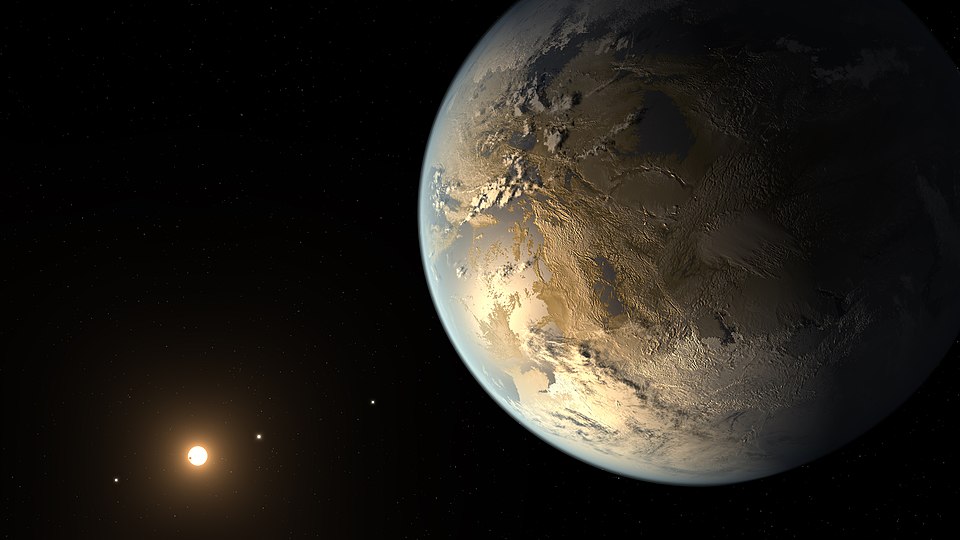
| Artist’s depiction of Kepler-186f (foreground) as a rocky Earth-like planet in the habitable zone, with the Kepler-186 system visible in the background (bottom left). The actual appearance and composition of the exoplanet is not currently known. | |
| Discovery[1] | |
|---|---|
| Discovered by | Elisa Quintana |
| Discovery site | Kepler space telescope |
| Discovery date | 17 April 2014 |
| Detection method | Transit |
| Designations | |
| Alternative names | KOI-571.05[2] |
| Orbital characteristics[3] | |
| Semi-major axis | 0.432+0.171 −0.053 AU |
| Eccentricity | 0.04+0.07 −0.04 |
| Orbital period (sidereal) | 129.9441+0.0013 −0.0012 d 0.355768 y |
| Inclination | 89.96°+0.04° −0.10° |
| Star | Kepler-186 |
| Physical characteristics | |
| Mean radius | 1.21±0.07 R🜨[4][2] |
| Mass | 1.44+2.33 −1.12 M🜨[1][a] |
| Temperature | Teq: 188 K (−85 °C; −121 °F)[citation needed] |

Kepler-186f[1][5] (also known by its Kepler object of interest designation KOI-571.05) is a candidate[6] Earth-sized exoplanet orbiting within the habitable zone of the red dwarf star Kepler-186,[7][8][9] the outermost of five such planets discovered around the star by NASA‘s Kepler space telescope. It is located about 580 light-years (180 parsecs) from Earth in the constellation of Cygnus.[10]
Kepler-186f orbits its star at a distance of about 0.43 AU (64,000,000 km; 40,000,000 mi) from its host star with an orbital period of roughly 130 days, and a radius around 1.17 times that of Earth. As one of the more promising candidates for habitability, it was the first planet with a radius similar to Earth’s to be discovered in the habitable zone of another star. However, key components still need to be found to determine its habitability for life, including an atmosphere, and its composition and if liquid water can exist on its surface.
Discovery and follow-up studies
Analysis of three years of data was required to find its signal.[11] NASA’s Kepler space telescope detected it using the transit method (in which the dimming effect that a planet causes as it crosses in front of its star is measured), along with four additional planets orbiting much closer to the star (all modestly larger than Earth).[8] The results were presented initially at a conference on 19 March 2014[12] and some details were reported in the media at the time.[13] The planet was announced on 17 April 2014,[5] simultaneously with publication of a scientific paper in Science.[1]
Some follow-up studies have indicated that Kepler-186f (like Kepler-452b) may still fall below the statistical threshold for confirmation, and so should still be considered a planet candidate.[6] The false positive probability was estimated to be 4% by a 2019 study[6]: 7 and 20% by a 2025 study.[14]
Physical characteristics
Mass, radius and temperature
The only physical property directly derivable from the observations (besides the orbit) is the size of the planet relative to the central star, which follows from the amount of occultation of stellar light during a transit. This ratio was measured to be 0.021,[1] giving a planetary radius of 1.17 ± 0.08 times that of Earth.[5][8] The planet is about 11% larger in radius than Earth (between 4.5% smaller and 26.5% larger), giving a volume about 1.37 times that of Earth (between 0.87 and 2.03 times as large).
A very wide range of possible masses can be calculated by combining the radius with densities derived from the possible types of matter from which planets can be made. For example, it could be a rocky terrestrial planet or a lower density ocean planet with a thick atmosphere. A massive hydrogen/helium (H/He) atmosphere is thought to be unlikely in a planet with a radius below 1.5 R🜨. Planets with a radius of more than 1.5 times that of Earth tend to accumulate the thick atmospheres which make them less likely to be habitable.[15] Red dwarfs emit a much stronger extreme ultraviolet (XUV) flux when young than later in life. The planet’s primordial atmosphere would have been subjected to elevated photoevaporation during that period, which would probably have largely removed any H/He-rich envelope through hydrodynamic mass loss.[1]
Mass estimates range from 0.32 M🜨 for a pure water/ice composition to 3.77 M🜨 if made up entirely of iron (both implausible extremes). For a body with radius 1.11 R🜨, a composition similar to that of Earth (i.e., 1/3 iron, 2/3 silicate rock) yields a mass of 1.44 M🜨,[1] taking into account the higher density due to the higher average pressure compared to Earth.[citation needed] That would make the force of gravity on the surface 17% higher than on Earth.
The estimated equilibrium temperature for Kepler-186f, which is the surface temperature without an atmosphere, is said to be around 188 K (−85 °C; −121 °F), somewhat colder than the equilibrium temperature of Mars.[16]
Host star
Main article: Kepler-186
The planet orbits Kepler-186, an M-type red dwarf star which has a total of five known planets. The star has a mass of 0.54 M☉ and a radius of 0.52 R☉. It has a temperature of 3755 K and is about 4 billion years old,[2] about 600 million years younger than the Sun, which is 4.6 billion years old[17] and has a temperature of 5,778 K (5,505 °C; 9,941 °F).[18]
The star’s apparent magnitude, or how bright it appears from Earth’s perspective, is 14.62. This is too dim to be seen with the naked eye, which can only see objects with a magnitude up to at least 6.5 – 7 or lower.[19]
Orbit
Kepler-186f orbits its star with about 5% of the Sun’s luminosity with an orbital period of 129.9 days and an orbital radius of about 0.40[2] times that of Earth’s (compared to 0.39 AU (58 million km; 36 million mi) for Mercury). The habitable zone for this system is estimated conservatively to extend over distances receiving from 88% to 25% of Earth’s illumination (from 0.23 to 0.46 AU (34 to 69 million km; 21 to 43 million mi)).[20] Kepler-186f receives about 32%, placing it within the conservative zone but near the outer edge, similar to the position of Mars in the Solar System.[1]
Habitability

See also: Habitability of red dwarf systems
Kepler-186f’s location within the habitable zone does not necessarily mean it is habitable; this is also dependent on its atmospheric characteristics, which are unknown.[21] However, Kepler-186f is too distant for its atmosphere to be analyzed by the most advanced instruments such as the James Webb Space Telescope.[8][22] A simple climate model – in which the planet’s inventory of volatiles is restricted to nitrogen, carbon dioxide and water, and clouds are not accounted for – suggests that the planet’s surface temperature would be above 273 K (0 °C; 32 °F) if at least 0.5 to 5 bars of CO2 is present in its atmosphere, for assumed N2 partial pressures ranging from 10 bar to zero, respectively.[23]
The star hosts four other planets discovered so far, although Kepler-186 b, c, d, and e (in order of increasing orbital radius), being too close to their star, are considered too hot to have liquid water. The four innermost planets are probably tidally locked, but Kepler-186f is in a higher orbit, where the star’s tidal effects are much weaker, so the time could have been insufficient for its spin to slow down significantly. Because of the very slow evolution of red dwarfs, the age of the Kepler-186 system was poorly constrained, although it is likely to be greater than a few billion years.[23] Recent results have placed the age at around 4 billion years.[2] The chance that it is tidally locked is approximately 50%.[24] Since it is closer to its star than Earth is to the Sun, it will probably rotate much more slowly than Earth; its day could be weeks or months long (see Tidal effects on rotation rate, axial tilt and orbit).[25]
Kepler-186f’s axial tilt (obliquity) is likely very small, in which case it would not have tilt-induced seasons like Earth’s. Its orbit is probably close to circular,[25] so it will also lack eccentricity-induced seasonal changes like those of Mars. However, the axial tilt could be larger (about 23 degrees) if another undetected non-transiting planet orbits between it and Kepler-186e; planetary formation simulations have shown that the presence of at least one additional planet in this region is likely. If such a planet exists, it cannot be much more massive than Earth as it would then cause orbital instabilities.[23]
One review essay in 2015 concluded that Kepler-186f, along with the exoplanets Kepler-442b and Kepler-62f, were likely the best candidates for being potentially habitable planets.[26]
In June 2018, studies suggest that Kepler-186f may have seasons and a climate similar to those on Earth.[27][28]
Gliese 667 Cc

Coordinates: 17h 18m 57.16483s, −34° 59′ 23.1416″
From Wikipedia, the free encyclopedia
| An artist’s impression of Gliese 667 Cc | |
| Discovery | |
|---|---|
| Discovery date | 2011 (mentioned), 2012 (announced) |
| Detection method | Radial velocity (European Southern Observatory) |
| Orbital characteristics | |
| Semi-major axis | 0.1251 (± 0.03) AU |
| Eccentricity | 0.133 (± 0.098) |
| Orbital period (sidereal) | 28.155 (± 0.017) d |
| Inclination | >30 |
| Semi-amplitude | 1.5 |
| Star | Gliese 667C |
| Physical characteristics | |
| Mean radius | ~1.7[1] R🜨 |
| Mass | >4.1[1] M🜨 |
| Temperature | 277 K (4 °C; 39 °F)[1] |

Gliese 667 Cc (also known as GJ 667 Cc, HR 6426 Cc, or HD 156384 Cc)[2] is an exoplanet orbiting within the habitable zone of the red dwarf star Gliese 667 C, which is a member of the Gliese 667 triple star system, approximately 23.62 light-years (7.24 parsecs; 223.5 trillion kilometres) away in the constellation of Scorpius. The exoplanet was found by using the radial velocity method, from radial-velocity measurements via observation of Doppler shifts in the spectrum of the planet‘s parent star. Gliese 667 Cc is sometimes considered as the first confirmed exoplanet with potential habitability.[3][4]
Physical characteristics
Mass, radius and temperature
Gliese 667 Cc is a super-Earth, an exoplanet with a mass and radius greater than that of Earth, but smaller than that of the giant planets Uranus and Neptune. It is heavier than Earth with a minimum mass of about 3.7 Earth masses.[5] The equilibrium temperature of Gliese 667 Cc is estimated to be 277.4 K (4.3 °C; 39.6 °F).[6] It is expected to have a radius of around 1.5 R🜨, dependent upon its composition.
Host star
Main article: Gliese 667 C
The planet orbits a red dwarf (M-type) star named Gliese 667 C, orbited by a total of two planets. The star is part of a trinary star system, with Gliese 667 A and B both being more massive than the smaller companion. Gliese 667 C has a mass of 0.31 M☉ and a radius of 0.42 R☉. It has a temperature of 3,700 K, but its age is poorly constrained, estimates place it greater than two billion years old. In comparison, the Sun is 4.6 billion years old[7] and has a surface temperature of 5,778 K.[8] This star is radiating only 1.4% of the Sun’s luminosity from its outer atmosphere. It is known to have a system of two planets: claims have been made for up to seven, but these may be in error due to failure to account for correlated noise in the radial velocity data. Since red dwarfs emit little ultraviolet light, the planets likely receive minimal amounts of ultraviolet radiation.
Gliese 667 Cc is the second confirmed planet out from Gliese 667 C, orbiting towards the inner edge of the habitable zone.[9] From its surface, the star would have an angular diameter of 1.24 degrees and would appear to be 2.3 times[note 1] the visual diameter of the Sun as it appears from the surface of the Earth. Gliese 667 C would have a visual area 5.4 times greater than that of the Sun but would still only occupy 0.003 percent of Gliese 667 Cc’s sky sphere or 0.006 percent of the visible sky when directly overhead.
The apparent magnitude of the star is 10.25, giving it an absolute magnitude of about 11.03. It is too dim to be seen from Earth with the naked eye, and even smaller telescopes cannot resolve it against the brighter light from Gliese 667 A and B.
Orbit
The orbit of Gliese 667Cc has a semi-major axis of 0.1251 astronomical units, making its year 28.155 Earth-days long. Based on its host star’s bolometric luminosity, GJ 667 Cc would receive 90% of the light Earth does; however, a good part of that electromagnetic radiation would be in the invisible infrared part of the spectrum.
The orbit of Gliese 667Cc is dynamically unstable due to the interactions between the other planets in the system. The eccentricity of its orbit changes every 4.6 years from 0.06–0.28 and 0.05–0.25. Simulations of the planet assuming a terrestrial mantle predicts that Gliese 667Cc is part of a 3:2 or higher spin-orbit resonance. These simulations also show that the tidal energy of both Gliese 667Cb and Gliese 667Cc are 10^23.7 and 10^26.7 J yr−1 respectively. This means that temperatures on this planet increase by 1.6 Kelvin every one hundred thousand years with at least the mantle being partially melted and is likely completely molten. This means that Gliese 667Cc quickly becomes a planet covered in lava.[10]
Habitability
See also: Habitability of red dwarf systems
Based on black body temperature calculation, Gliese 667 Cc should absorb a similar, but slightly higher, amount of overall electromagnetic radiation than Earth, making it a little warmer (277.4 K [4.3 °C; 39.6 °F]) and consequently placing it slightly closer to the “hot” inner edge of the habitable zone than Earth (254.3 K [−18.8 °C; −1.9 °F]).[11] According to the Planetary Habitability Laboratory (PHL), Gliese 667 Cc is (as of July 2018) the fourth-most Earth-like exoplanet located in the conservative habitable zone of its parent star.[12]
Its host star is a red dwarf, with about a third as much mass as the Sun. As a result, stars like Gliese 667 C may live up to 100–150 billion years, 10–15 times longer than the Sun’s lifespan.[13] This, however, does not equate to a longer period of favorable conditions for life. A 2017 paper employed bayesian inference to show that if Earth is assumed to be typical of a habitable planet, then there must be some constraint that prohibits habitability and the evolution of life on planets that orbit stars of less than 0.65 M☉.[14] Given that Gliese 667 Cc orbits a star of mass 0.31 M☉, its chances of habitability may be considerably smaller than estimates based purely on how Earth-like the planet is.
Furthermore, the planet is likely tidally locked, with one side of its hemisphere permanently facing towards the star, and the opposite side being dark and cold. However, between these two intense areas, there could be a sliver of habitability—called the terminator line, where the temperatures may be suitable (about 273 K [0 °C; 32 °F]) for liquid water to exist. Additionally, a much larger portion of the planet may be habitable if it supports a thick enough atmosphere to transfer heat to the side facing away from the star.
However, in a 2013 paper, it was revealed that Gliese 667 Cc is subject to tidal heating 300 times that of Earth. This in part is due to its small eccentric orbit around the host star.[15] Further simulations of the interaction between Gliese 667Cc and Gliese 667Cb show that it would be subjected to intense tidal energies. The energy that it is subjected to would warm the planet up by 1.6 Kelvin every one hundred thousand years causing the partial or complete melting the mantle and covering the surface in lava. Because of this, the chances of habitability are very likely to be lower than originally estimated.[10]
Discovery
Gliese 667 Cc was first announced in a pre-print made public on 21 November 2011 by the European Southern Observatory‘s High Accuracy Radial Velocity Planet Searcher (HARPS) group using the radial velocity method (Doppler method).[16] The announcement of a refereed journal report came on 2 February 2012 by researchers at the University of Göttingen and the Carnegie Institution for Science and backing up the ESO HARPS group discovery.[17]
Nu2 Canis Majoris b

Coordinates: 06h 36m 41.04s, −19° 15′ 21.2″
From Wikipedia, the free encyclopedia
| Artist’s impression | |
| Discovery | |
|---|---|
| Discovered by | Wittenmyer, Robert A |
| Discovery date | December 2011 |
| Detection method | Radial Velocity |
| Orbital characteristics | |
| Semi-major axis | 1.9 ± 0.1 AU (284,000,000 ± 15,000,000 km) |
| Eccentricity | 0.14 ± 0.06 |
| Orbital period (sidereal) | 763 ± 17 d |
| Time of periastron | 2455520 ± 89 |
| Argument of periastron | 12 ± 41 |
| Star | Nu2 Canis Majoris |

Nu2 Canis Majoris b, (7 CMa b) is a water cloud jovian extrasolar planet orbiting the star Nu2 Canis Majoris, approximately 64.71 light years away in the constellation of Canis Major. It was discovered in 2011 by Wittenmyer, R. by radial velocity.[1]
Gliese 433 – Red dwarf
- “M dwarf” redirects here. For substellar objects, see brown dwarf.
| Red dwarf | |
|---|---|
| Proxima Centauri, the closest star to the Sun, at a distance of 4.2 ly (1.3 pc), is a red dwarf. | |
| Characteristics | |
| Type | Class of small main sequence star. |
| Mass range | 0.08 – 0.6 M☉ |
| Temperature | 2,400 – 3,900 K |
| Average luminosity | 0.0003 – 0.07 L☉ |
| External links | |
| Media category | |
| Q5893 | |


A red dwarf is the least massive, smallest, least luminous, and coolest kind of star on the main sequence. Red dwarfs are by far the most common type of fusing star in the Milky Way, at least in the neighborhood of the Sun. However, due to their low luminosity, individual red dwarfs are not easily observed. Not one star that fits the stricter definitions of a red dwarf is visible to the naked eye.[1] Proxima Centauri, the star nearest to the Sun, is a red dwarf, as are fifty of the sixty nearest stars. According to some estimates, red dwarfs make up three-quarters of the fusing stars in the Milky Way.[2]
The coolest red dwarfs near the Sun have a surface temperature of about 2,000 K and the smallest have radii about 9% that of the Sun, with masses about 7.5% that of the Sun. These red dwarfs have spectral types of L0 to L2. There is some overlap with the properties of brown dwarfs, since the most massive brown dwarfs at lower metallicity can be as hot as 3,600 K and have late M spectral types.
Definitions and usage of the term “red dwarf” vary by how inclusive they are on the hotter and more massive end. One definition is synonymous with stellar M dwarfs, yielding a maximum temperature of 3,900 K and 0.6 M☉. Another includes all stellar M-type main-sequence and all K-type main-sequence stars (K dwarf), yielding a maximum temperature of 5,200 K and 0.8 M☉. Some definitions include any stellar M dwarf and part of the K dwarf classification. Other definitions are also in use. Many of the coolest, lowest-mass M dwarfs are expected to be brown dwarfs, not true stars, and so those would be excluded from any definition of red dwarf.
Stellar models indicate that red dwarfs less than 0.35 M☉ are fully convective.[3] Hence, the helium produced by the thermonuclear fusion of hydrogen is constantly remixed throughout the star, avoiding helium buildup at the core, thereby prolonging the period of fusion. A low-mass red dwarf therefore develops very slowly, maintaining a constant luminosity and spectral type for trillions of years, until its fuel is depleted and it turns into a blue dwarf. Because of the comparatively short age of the universe, no red dwarfs yet exist at advanced stages of evolution.
HAT-P-27 b

HAT-P-27 b is a gas giant exoplanet that orbits a G-type star. Its mass is 0.62 Jupiters, it takes 3 days to complete one orbit of its star, and is 0.04 AU from its star. Its discovery was announced in 2011.
HD 137388 b
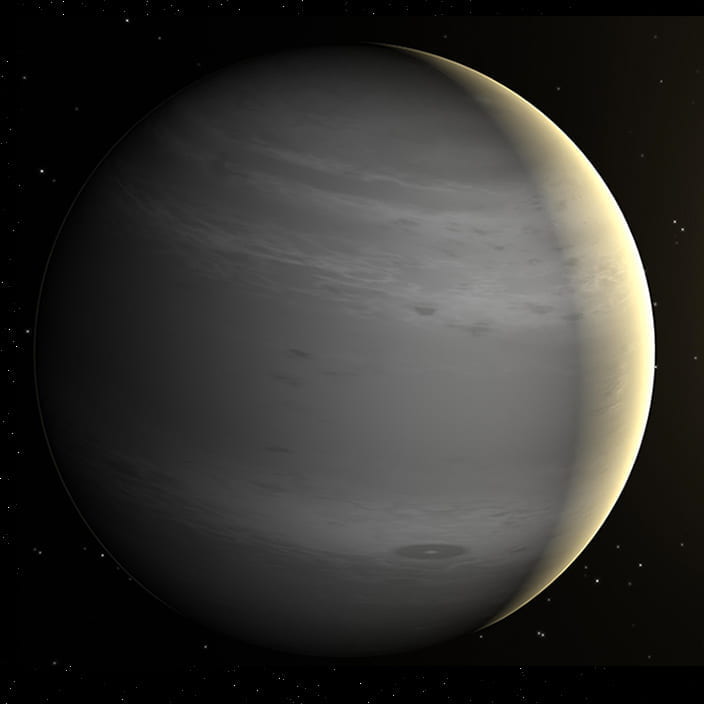
HD 137388 b is a gas giant exoplanet that orbits a K-type star. Its mass is 0.2 Jupiters, it takes 330 days to complete one orbit of its star, and is 0.89 AU from its star. Its discovery was announced in 2011.
Karaka is located 127.96 light years or 39.23 parsecs from the Earth based on the latest parallax records from the Hipparcos satellite. It would take 127.96 years travelling at the speed of light to get there. Both the star and the planet can be located in the southern hemisphere constellation of Apus. It is not possible to see either the exoplanet or the star just looking up in the night sky as it is too dim.
The Orbital Period, or to say it another way, HD 137388 b’s year is 330 days or 0.90 Earth Years. By the time, the Earth has completed a full year, the planet will have completed 1.11 orbits of its star .
Eccentricity of HD 137388 b is 0.36. It is a measure of how circular the orbital path of the exoplanet is. If the value is zero, the orbital path is a perfect circle. The max value is 1 meaning its an ellipse.
The Semi-Major Axis is the furthest point from its star in its orbit. The Earth travels round the Sun with a semi-major axis just over 1 A.U. ( 1.00000011). 1 A.U. is the average distance of the Earth from the Sun. The planet orbits Karaka at a closer distance than Mars does to the Sun.